

How Should You Plan Water Leak Detection?
By David K
8 min read

Plan water leak detection as part of the plumbing system, not as a collection of wireless sensors added after move-in. Keep the manual main shutoff easy to find and operate, decide whether a whole-home flow monitor should also close the water automatically, and place moisture sensors where a drain leak, appliance connection, water heater, condensate line, or other local problem could escape the main-line monitor. Coordinate pipe size, straight pipe length, service access, power, connectivity, alerts, fire-sprinkler separation, and any outdoor or irrigation branches before rough-in. Then test the installed system with realistic events, document what each alert or shutoff means, and give the homeowner control of the accounts and an annual maintenance routine.
Planning a new home? Explore Max Built's custom-home process, then view the craftsmanship in our project portfolio.
Define what the system must detect before choosing devices
Begin with a map of every place water enters, moves through, or drains from the home. Include the domestic-water entry, water heaters, kitchens, baths, laundry, refrigerators, dishwashers, filtration or treatment equipment, humidifiers, condensate systems, hose connections, irrigation, and any pool or outdoor-living supply that is part of the project. Mark which branches remain active when the house is unoccupied and which rooms sit above finished space.
EPA WaterSense separates leak protection into two useful categories. Point-of-entry flow monitors watch water use downstream from the main line and can flag unusual flow or pressure patterns. Point-of-use moisture sensors react to water where it should not be, such as beside a washer, under a sink, or near a water heater. Neither approach sees every failure: a main-line monitor cannot detect a roof or drain leak that does not draw supply water, while a floor sensor protects only the location where it is placed.
Use that limitation as the design brief. A practical custom-home strategy may combine one serviceable whole-home monitor with selected local sensors instead of scattering devices everywhere. Define whether each device only sounds an alarm, sends a remote alert, closes a fixture valve, or closes the domestic-water main. Also decide which events should require a person to inspect the home before water is restored.
- Which water branches are downstream of the proposed whole-home monitor?
- Where could a small leak remain hidden until it damages finishes below?
- Which sources, such as drains or HVAC condensate, need local moisture sensing?
- Who receives alerts, and what action should follow each alert?
Coordinate the manual shutoff and whole-home monitor as one assembly
The manual main shutoff remains essential even when the home has an automatic valve. Place it where the homeowner can reach it quickly without a ladder, a key, or moving stored items. Show the valve, water meter or service entry, pressure-control equipment, treatment equipment, monitor, drain provisions, and branch takeoffs on the plumbing drawings so the installation sequence is clear.
An in-line monitoring device needs more than an available length of pipe. The selected model may have requirements for pipe size, flow direction, straight pipe, orientation, pressure, indoor or outdoor rating, power, wireless signal, service clearance, and upstream or downstream components. EPA WaterSense recommends understanding product limitations, providing enough pipe length, and keeping the device accessible. Have the plumbing professional coordinate the actual product with the home's water service and current project requirements.
Decide what the device will and will not isolate. Irrigation, fire protection, accessory structures, pools, treatment bypasses, and other branches can change both monitoring coverage and the consequence of a shutoff. EPA specifically cautions that a leak-detection device should not interfere with a home fire-sprinkler system. The plumber, fire-protection designer when applicable, builder, manufacturer, and permit authority should resolve the final arrangement for the property rather than copying a diagram from another house.
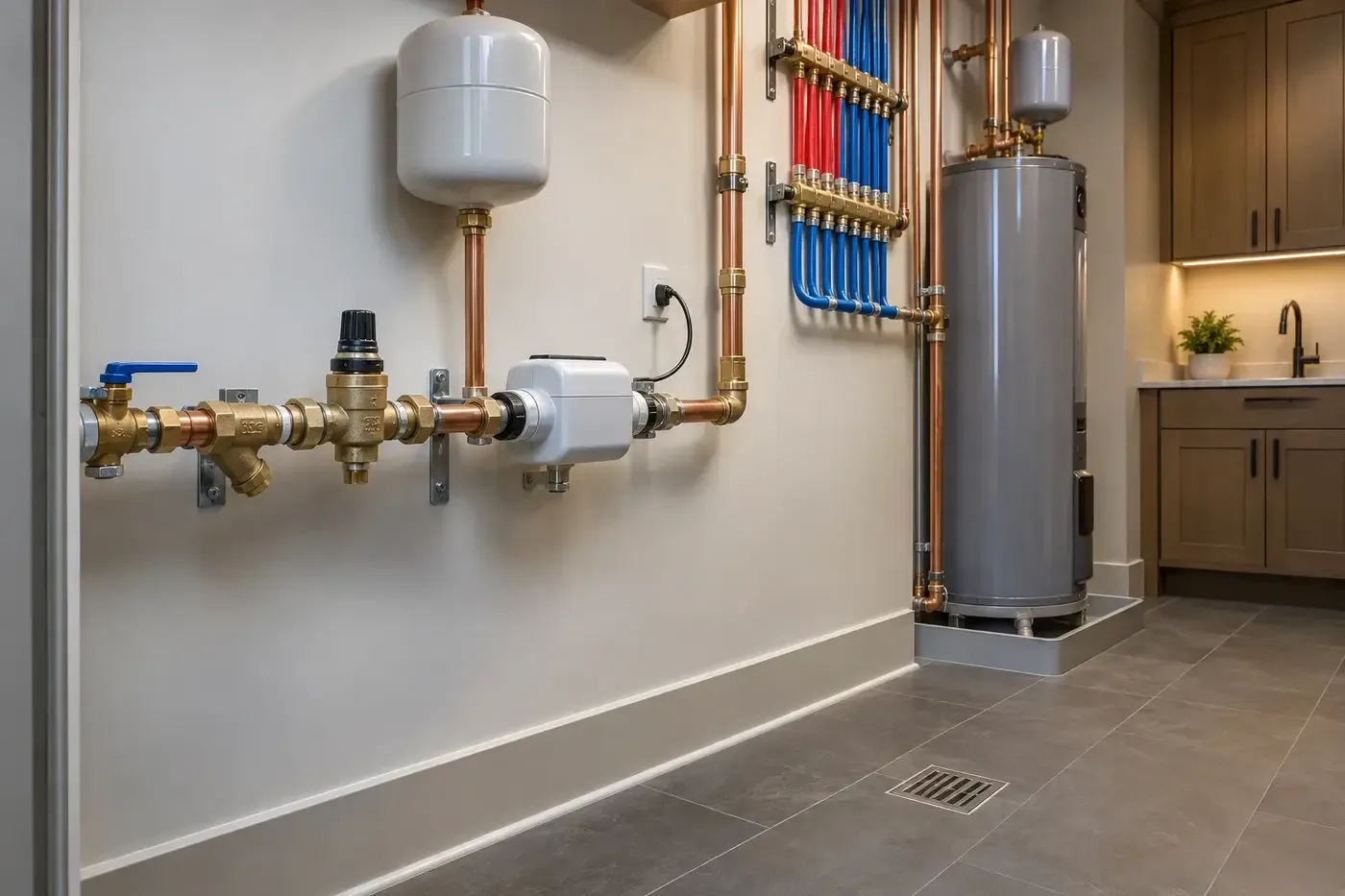
Place local sensors where water would collect first
Local moisture sensors are most useful when they sit in the likely first path of escaping water and remain visible enough to test. Candidate locations include washing-machine connections, water heaters, refrigerator and dishwasher supply areas, filtration equipment, under-sink cabinets, mechanical condensate equipment, and plumbing fixtures above finished rooms. The correct locations depend on the actual floor slopes, pans, curbs, cabinetry, and drain paths—not on a generic room list.
A sensor hidden behind a tightly fitted appliance may be hard to test or replace, while a sensor placed on a high spot may stay dry as water runs around it. Review the finished floor and cabinet details, leave a practical path for inspection, and coordinate any remote probe or sensor cable before millwork is installed. In a humid mechanical or crawlspace condition, confirm that the selected sensor is rated and adjusted for that environment so ordinary moisture does not create repeated false alarms.
Use physical water-management details alongside electronics. Accessible fixture shutoffs, correctly selected pans or drains where appropriate, protected supply connections, waterproofing, and a clear route away from sensitive finishes still matter. Leak detection can shorten the response time, but it does not correct a poor connection, blocked drain, inaccessible valve, or unfinished waterproofing transition.
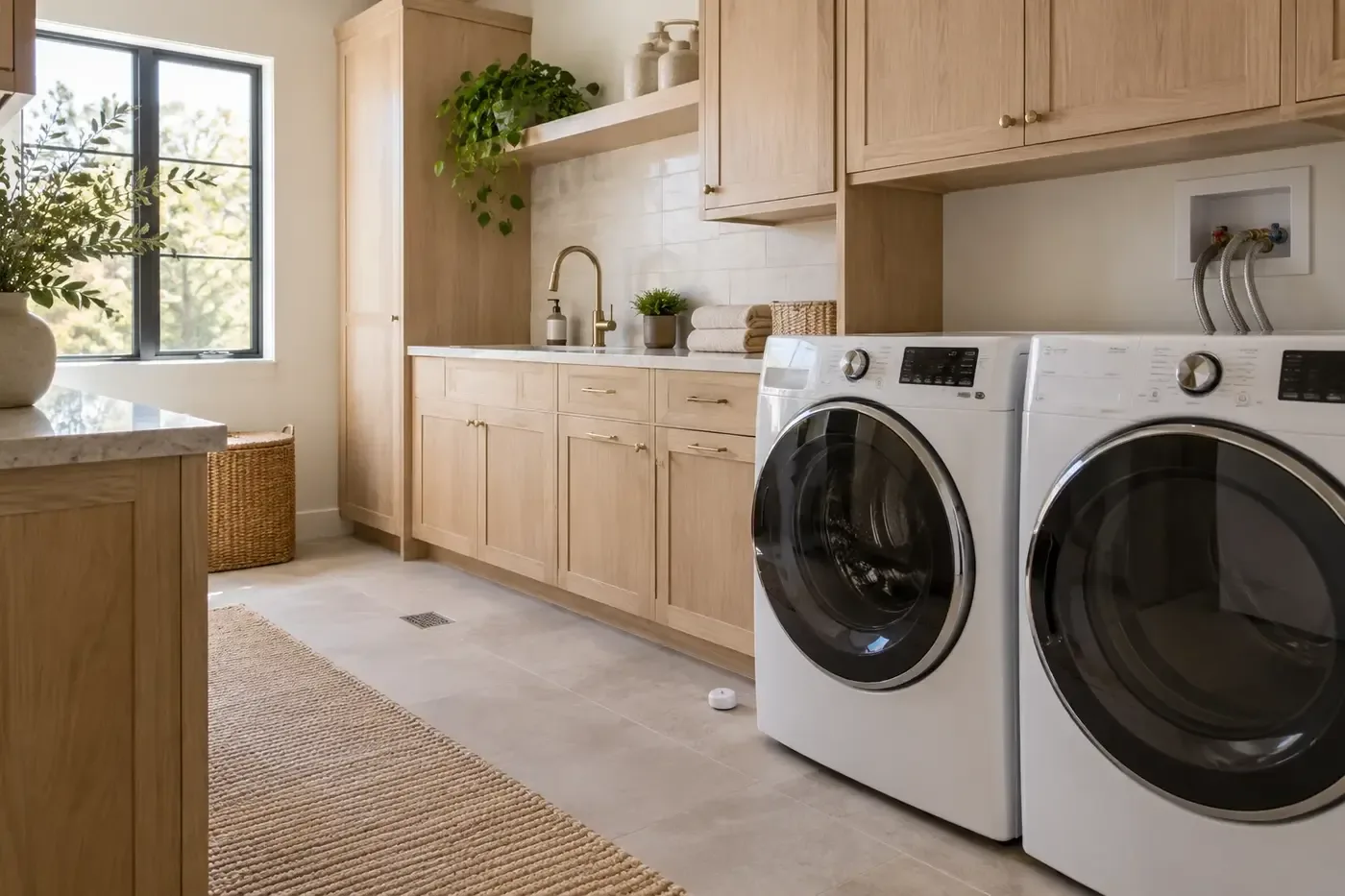
Plan power, connectivity, control, and failure behavior
If the whole-home valve or hub requires power, provide an approved nearby source that will not be casually unplugged to run another appliance. Ask what happens during a power outage, after a drained battery, or when the home's internet service is down. Some systems can still detect or close locally while remote alerts are unavailable; others depend more heavily on a hub or cloud connection. Confirm the behavior from the selected manufacturer's current instructions.
Coordinate wireless coverage with the home's network plan, especially when the water entry is in a remote mechanical room, crawlspace, basement, or detached structure. If point sensors communicate through a hub, test the actual path after equipment, cabinets, doors, masonry, and finishes are installed. A device showing as connected during an early open-framing walk does not prove reliable communication in the completed home.
Keep homeowner control straightforward. Decide who receives alerts, who can close or reopen the valve remotely, whether a subscription is required, and how installer access will be removed at handover. Do not place passwords or recovery codes on public drawings. Record the device locations, account owner, model information, battery type, support contact, and reset procedure in a private homeowner file.
Commission the system and hand over a response plan
Test the basic plumbing before relying on monitoring technology. EPA's WaterSense new-home materials call for pressure-loss testing and visual inspection to confirm a home is free of detected leaks. The responsible professionals should also verify accessible valves, appliance connections, drain and pan paths, and any selected monitoring equipment under the procedures that apply to the project.
Then create controlled test events for the installed system. Confirm that each point sensor reports the correct room, the main monitor recognizes the intended abnormal-flow condition, every notification reaches the right account, and an automatic valve closes and reopens as designed. Verify that outdoor branches, irrigation, specialty equipment, and fire protection behave exactly as documented. Do not create uncontrolled water releases or override safety equipment for testing.
At handover, give the homeowner a marked plan showing the manual shutoff, automatic valve, sensors, hubs, power sources, monitored branches, and excluded sources. Demonstrate how to silence an alarm, inspect the affected area, contact the appropriate professional, and restore water only after the cause is understood. Set reminders to test devices, replace batteries, clean sensors, confirm internet reconnection after network changes, and exercise valves according to the manufacturers' instructions. Max Built can help coordinate this planning with the plumbing, electrical, low-voltage, cabinetry, and closeout work while the custom home is still open enough to make the system accessible.
Sources and editorial notes
EPA WaterSense guide to leak detection and flow monitoring devices
EPA WaterSense technical sheet for new-home leak detection systems
Insurance Institute for Business & Home Safety interior water-damage guidance
North Carolina Office of the State Fire Marshal current code resources
Prepared with AI assistance and editorially reviewed by Sage. Architectural images are illustrative, not documented Max Built projects. This organizational guide does not replace project-specific professional advice.
Water leak-detection questions for a Charlotte custom home
Is a whole-home flow monitor enough by itself?
Not always. It can monitor water moving through the pipe downstream from its installation, but it may not detect a drain leak, HVAC condensate leak, roof leak, or water that escapes upstream. Local moisture sensors can cover selected areas that a flow monitor cannot see.
Where should an automatic water shutoff be installed?
Its location depends on the service entry, pipe size, branch layout, pressure equipment, treatment equipment, fire protection, product requirements, power, connectivity, and service access. Have the plumber and project team coordinate the selected device on the actual plans rather than assigning a generic location.
Should the manual main shutoff remain accessible?
Yes. Homeowners still need a clearly labeled, reachable manual way to isolate the domestic-water system. Automatic controls should not hide the manual valve or make emergency operation depend on an app, account, or internet connection.
Which rooms benefit most from local moisture sensors?
Prioritize water heaters, laundry connections, appliance supplies, filtration equipment, under-sink cabinets, mechanical condensate equipment, and plumbing above sensitive finished areas. Final placement should follow the room's real floor slope, pans, drains, cabinetry, and access.
What should be tested before move-in?
Verify the plumbing is free of detected leaks, confirm each sensor reports the correct location, test alerts and authorized shutoff behavior, document monitored and excluded branches, check backup power and connectivity behavior, and give the homeowner the valve map, account control, manuals, and maintenance schedule.
Build the right plan before construction begins
Tell us about your property, priorities, and the way you want to live. We'll help organize the next decisions around a clear, buildable path.