

Surge Protection for Custom Homes
By David K
8 min read

Whole-house surge protection belongs in the electrical plan for a new custom home, but one device should not be treated as a guarantee against every electrical event. Start with the surge-protective device required by the applicable electrical design and adopted code, usually coordinated at or near the service equipment. Then identify sensitive or multi-connected equipment that may benefit from compatible point-of-use protection. Grounding, bonding, conductor routing, panel compatibility, communications entries, generator or solar interfaces, status indication, and future replacement all affect the result. A qualified electrical professional should select and install the system for the actual service and equipment. Surge protection is different from backup power, voltage regulation, and a lightning-protection system, so define which problem each part of the plan is meant to address.
Planning a new home? Explore Max Built's custom-home process, then view the craftsmanship in our project portfolio.
Define what surge protection can—and cannot—do
A surge is a brief overvoltage event that can enter on utility conductors or develop within an electrical system when equipment switches. Modern homes contain controls and electronics in HVAC equipment, appliances, lighting, security, networking, pumps, motorized features, and life-safety devices. That makes surge planning a whole-home coordination question rather than a television-accessory decision.
A surge-protective device responds by limiting transient voltage and diverting surge current. It does not create electricity during an outage, correct every sustained high- or low-voltage condition, or make an electrical system immune to a direct lightning strike. NIST distinguishes surge protection from other power-quality problems, while NFPA notes that service-level protection does not eliminate the value of protection for selected sensitive equipment.
Write the goal before choosing products. The plan may need to protect service-connected equipment broadly, add another layer for valuable electronics, coordinate power and communications paths, or integrate with a separately designed lightning-protection system. Clear scope prevents a single box beside the panel from being described as complete protection for every possible event.
- Which hardwired controls and appliances contain sensitive electronics?
- Which devices connect to both power and data, cable, antenna, or outdoor wiring?
- Does the project include a generator, battery, solar array, well, gate, pool, or detached structure?
- Who will inspect status indicators and replace a device that reaches end of life?
Start with the service and distribution equipment
The 2020 National Electrical Code introduced a requirement for a Type 1 or Type 2 surge-protective device for dwelling-unit services. The code adopted for the project, local amendments, utility arrangement, service design, and permit review determine the exact requirement. Confirm those inputs with the electrical designer, contractor, and authority having jurisdiction instead of assuming that a national code edition applies unchanged to every Charlotte-area address.
NEMA describes Type 1 and Type 2 devices as permanently connected equipment, with their permitted locations and applications differing. Product type alone does not settle the design. The selected device must suit the system voltage, service configuration, available fault current, panel or enclosure, connection method, environmental conditions, and other published ratings. A qualified electrical professional should verify those details and the listing for the intended use.
Reserve the location while the electrical room, meter, disconnects, and panels are being planned. Keep required working clearances, use a connection arrangement consistent with the manufacturer's instructions, and avoid burying the indicator or replacement path behind millwork or stored items. A clean, accessible installation makes the protective device easier to inspect and less likely to be forgotten after move-in.
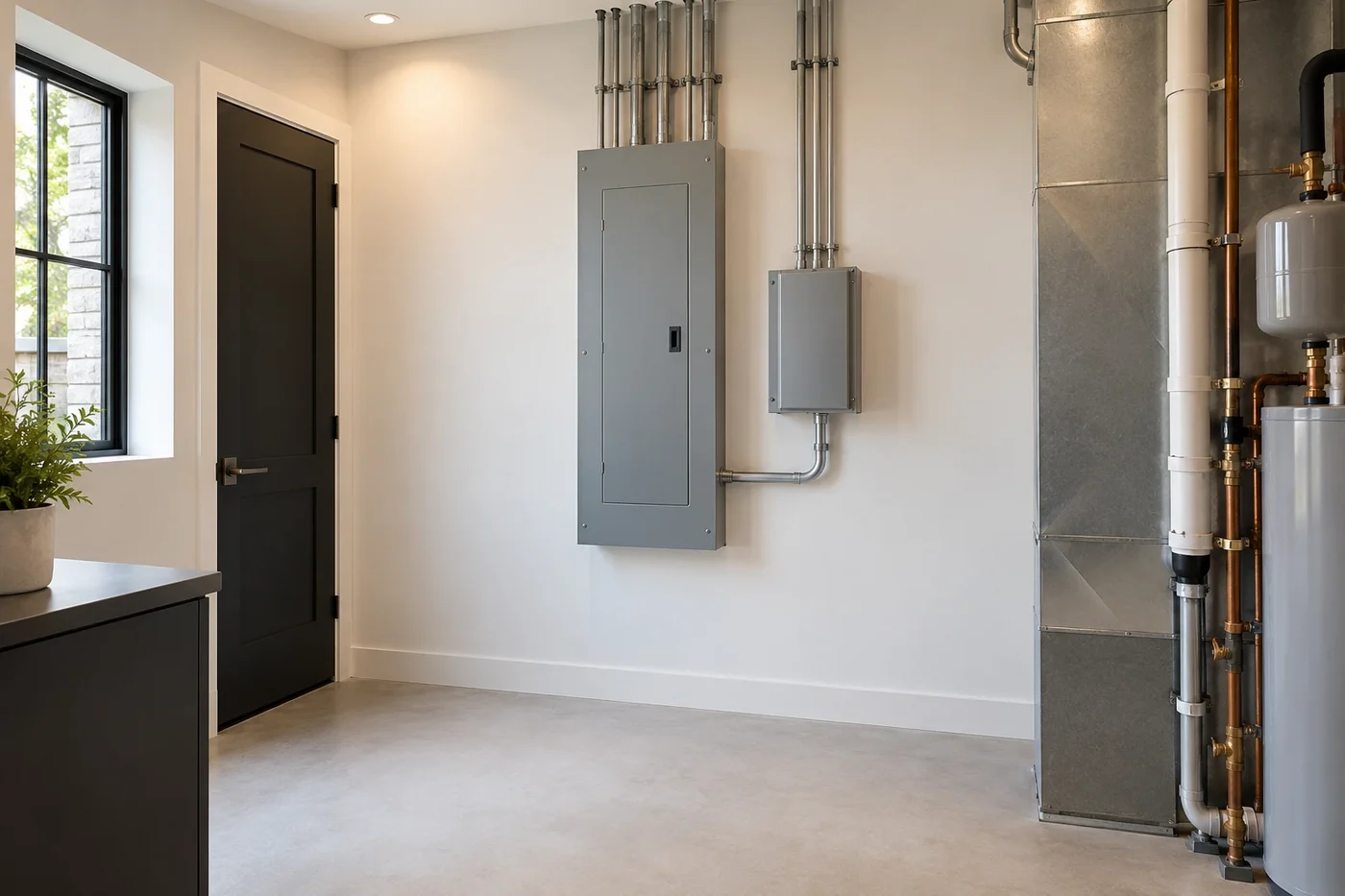
Use layers for sensitive and multi-connected equipment
A service-level device provides broad protection, but it is not the same as a point-of-use device beside a particular load. NIST describes a layered approach in which protection at the service can be complemented by suitable protection near sensitive equipment. That second layer can matter for electronics connected through more than one path, such as power plus internet, cable, antenna, gate wiring, or an outdoor control circuit.
Inventory the actual equipment instead of installing generic strips everywhere. Discuss televisions, network hardware, audio systems, office equipment, security controls, automated shades, elevators when included, pool or spa controls, irrigation, gate operators, and specialty appliances. Some products have manufacturer-specific protection, warranty, receptacle, or connection requirements that need to be reconciled with the electrical design.
A power strip is not automatically a surge protector. Where point-of-use protection is selected, confirm that it is a listed surge-protective device for the intended application, that all relevant connection paths are addressed appropriately, and that indicator lights remain visible. Do not route building wiring, communications conductors, or grounding connections through improvised consumer accessories.
Coordinate grounding, bonding, and every incoming path
Surge current needs an intentional path. Grounding and bonding, service conductors, panel arrangement, device connection length, communications entries, and metal systems should be reviewed as one coordinated installation. NIST's residential guidance emphasizes the problems that can arise when power and communications systems do not share an appropriate grounding reference.
Map every conductor that enters the house or links buildings: utility power, internet or cable, antennas, gates, landscape controls, wells, pumps, pool equipment, detached garages, and other outdoor systems. The responsible professionals should determine the required bonding, protection, separation, and transition details for each system. Protecting only the main power panel may leave another connected route outside the plan.
Generators, batteries, solar equipment, transfer switches, and exterior disconnects add interfaces that should be shown on the one-line diagram. Ask how the surge-protection strategy operates in each source configuration and whether the manufacturers require specific devices or locations. This is design work for qualified professionals; homeowners should use the questions to make sure the interfaces are not omitted.

Plan verification, records, and replacement before move-in
Before close-in, compare the electrical one-line, panel schedules, equipment submittals, communications plan, and any generator, battery, solar, gate, pool, or detached-building drawings. Confirm that specified surge-protective devices remain compatible with the equipment actually purchased. Field substitutions should receive the same rating and installation review as the original selection.
At startup, have the responsible electrical professional verify the installation, required labels, device status, and coordination with the completed grounding and bonding system. Record manufacturer, model, location, installation instructions, warranty information, status indication, and the response for a failed or end-of-life signal. Photograph accessible equipment and include it in the home's electrical handoff documents.
Surge-protective devices can be damaged or reach the end of their useful service. Put indicator checks on the homeowner maintenance list and define who should evaluate the system after a known electrical event. Mecklenburg County warns that electrical work is hazardous and urges homeowners to use North Carolina-licensed electrical contractors; service equipment and permanently connected protection are not appropriate do-it-yourself tasks.
Ask for a coordinated surge-protection plan
The useful deliverable is not a vague allowance for ‘whole-house protection.’ Ask for the device type and intended location, the basis for product selection, the equipment and incoming systems covered by the strategy, any point-of-use layers, the grounding and bonding coordination, and the inspection and handoff requirements. Keep these decisions aligned with the permit set and electrical specifications.
Also write down the boundaries. Surge protection does not replace backup power, an uninterruptible power supply for equipment that must ride through an outage, or a separately engineered lightning-protection system. If the household expects any of those functions, name them independently and coordinate their interfaces rather than assuming one product performs all of them.
Max Built can help keep the electrical plan, equipment locations, architectural details, low-voltage routes, and closeout records coordinated while a new custom home is still flexible. Final electrical design, product selection, installation, permitting, and inspection should remain with the qualified professionals responsible for the project.
Sources and editorial notes
NIST guide to residential surge protection
NFPA overview of residential surge-protection requirements
NEMA guide to surge-protective device types
Mecklenburg County electrical information for homeowners
Prepared with AI assistance and editorially reviewed by Sage. Architectural images are illustrative, not documented Max Built projects. This organizational guide does not replace project-specific professional advice.
Whole-house surge-protection questions
Is whole-house surge protection required for a new custom home?
The 2020 NEC introduced service-level surge protection for dwelling units, but the requirement for a specific project depends on the electrical code and amendments adopted by the jurisdiction, the service design, and permit review. Confirm the current requirement with the electrical professional and authority having jurisdiction for the property.
Does a whole-house surge protector replace plug-in protection?
Not necessarily. A service-level device provides broad protection, while selected sensitive or multi-connected equipment may benefit from compatible point-of-use protection. The electrical and low-voltage professionals should coordinate the layers and every connection path.
Will surge protection keep the power on during an outage?
No. Surge protection limits brief overvoltage events. Backup generators, batteries, and uninterruptible power supplies address different outage or ride-through needs and require their own design and coordination.
Does a surge protector protect a house from a direct lightning strike?
A surge-protective device is not a complete structural lightning-protection system and should not be described as a guarantee against a direct strike. If lightning protection is a project goal, discuss a coordinated system with qualified professionals and integrate its grounding, bonding, and surge-protection requirements.
Where should a whole-house surge protector be installed?
The permitted location depends on whether the selected device is Type 1 or Type 2, the service and panel arrangement, the adopted code, and the manufacturer's instructions. It is commonly coordinated at or near service or distribution equipment by a qualified electrical professional.
What records should the homeowner receive?
Keep the device manufacturer and model, ratings, location, installation instructions, warranty, status-indicator meaning, replacement procedure, electrical one-line or panel information, inspection records, and photographs of the completed accessible installation.
Build the right plan before construction begins
Tell us about your property, priorities, and the way you want to live. We'll help organize the next decisions around a clear, buildable path.